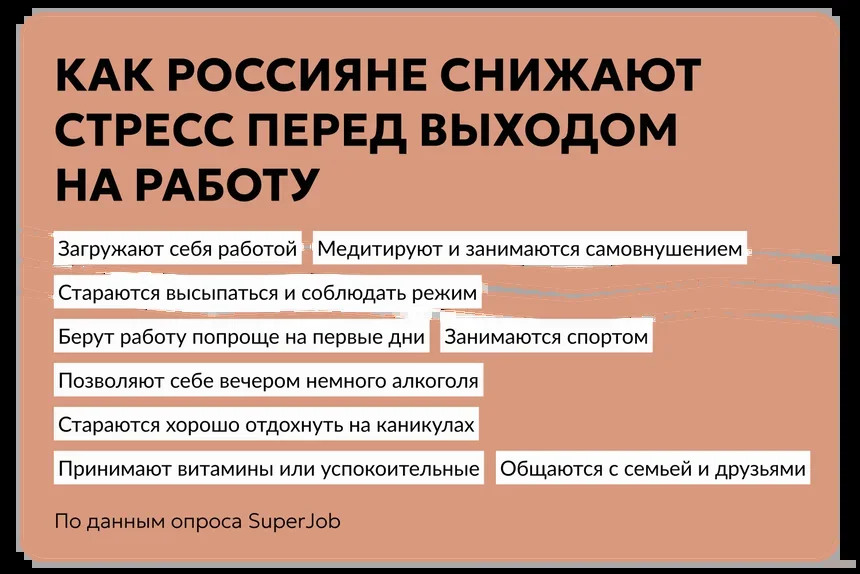

For many, the return to work after the holidays requires a period of adjustment. Sometimes this adjustment can be painful and met with resistance. After days of relaxation, cozy evenings with loved ones, and the freedom to do as you please, it’s tough to suddenly adhere to a strict schedule and tackle complex tasks. We spoke with a clinical psychologist to explore how to navigate this battle for productivity with minimal strain.

**Rest Properly During the Holidays**
It’s no surprise that working effectively after a break is possible only if you truly rested. But how often do you finish your vacation feeling recharged and ready? The issue isn’t always the duration of the break, but rather how you spend it.
First, ask yourself: Are you actually resting or tackling a million backlogged tasks? Deep cleaning, clearing emails, shuttling kids to events, planning new projects, or starting renovations—if your list is endless, it’s time to consider whether you allow yourself to truly unwind.
Second, evaluate what you consider rest. Under the mantra “the best rest is a change of activity,” you might cram your days with museum visits, family gatherings, excursions, and social outings. While new experiences can energize you, it’s important to identify which activities truly recharge you and which overwhelm you. Are you choosing for yourself, or just following what you think you “should” do?
Notice if your energy dips depending on who you’re with or what you’re doing. For example, a loud party with bright lights might drain you. Learn to say no to such activities and people. And don’t criticize yourself if you simply want a couple of lazy days with a blanket, a show, and a warm cup of tea. Slowing down is a vital part of rest.
**Adjust Your Routine in the Last Days of the Break**
The stress of returning to work often stems from the sharp contrast between freedom and structure, as well as accumulated fatigue from the holiday itself—from late nights, overindulgence, and lack of movement. After such a break, you might need another vacation. Begin restoring your routine not on the last day before work, but at least two to three days earlier (if your holiday length allows).
**Restore Your Sleep Schedule**
You need to catch up on sleep, but that doesn’t mean staying in bed until noon. Start going to bed earlier—no later than 11 p.m. or whatever suits your schedule—a couple of days before returning to work.
Create rituals to ease into sleep: stretching, meditation, evening wind-downs, soft warm lighting, a warm bath, or a short walk. Find what works for you. Walking into a new work week with massive sleep debt is a shock to your system, and you’ll need to sustain that energy for months ahead.
**Incorporate More Movement**
If you overate during the holidays and were mostly sedentary, your body feels sluggish. Just like an athlete returning to training after a break, gentle movement helps your body readjust. Start with short walks, light stretching, or a quick morning exercise. This boosts circulation, improves mood, and reduces the shock of returning to a desk job.
**Ease Back into Work Gradually**
Don’t try to conquer your entire to-do list on the first day. Plan your first few days with lighter tasks: organizing, planning, responding to non-urgent emails. This reduces pressure and builds momentum. Consider using the “Pomodoro technique” – work for 25 minutes, then take a 5-minute break – to stay focused without burnout.
**Manage Expectations and Communicate**
Tell colleagues you’re easing back in, set realistic goals for the first week, and don’t overload your calendar. It’s okay to say no to new projects for a few days. The key is to create a smooth transition, not a jolt. Much like a sports team’s preseason training, gradual buildup leads to peak performance without injuries.
By following these steps—resting intentionally, adjusting routines, and gradually re-entering the work rhythm—you can return to work with less stress and more energy. Remember, the goal isn’t to power through your first week at full speed, but to regain your stride sustainably.